

KLAS is constantly talking to both payers and providers about their technology investments. Over the last two years, both sides have put significant resources toward workflow automation to drive efficiency, but up to this point, investment has often automated broken processes rather than foster collaboration between payers and providers. Where organizations have collaborated on innovative approaches with some of their providers or payers, they typically haven’t extended those approaches to all.
The unintended consequence is increased friction between providers and payers rather than a reduction of administrative waste.
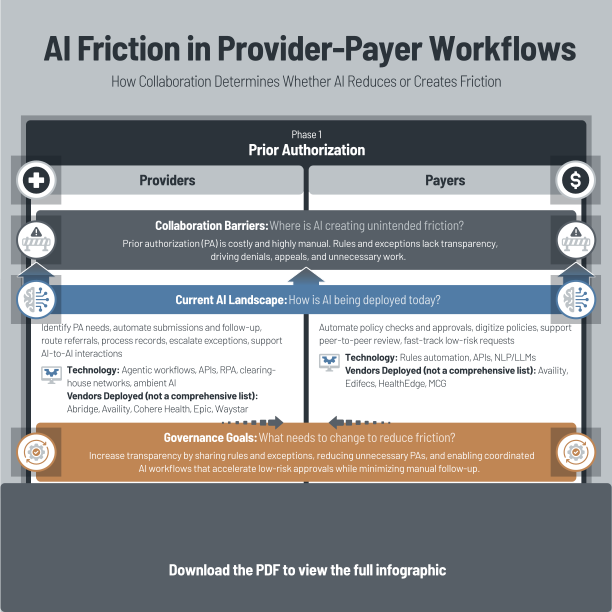
Though KLAS is planning to publish several reports about where AI is impacting revenue cycle and highlight vendor differentiation, this blog includes an infographic that is intended to educate the market about where the quickly evolving landscape is at and how organizations can best see ROI through foundational collaboration.
Where Friction Is Most Notable
As KLAS has spoken with the market, friction is most notable in several revenue cycle management and payer-provider administrative workflow phases. These are:
- Prior authorizations
- Documentation, coding & claim creation
- Denials, appeals & grievances
- Payment integrity & audits
There are attempts to use AI to automate workflows in each area, and modern FHIR APIs are seen as important infrastructure to support AI workflows. But without strong governance across both payer and provider organizations, AI tools can struggle to complete tasks and at times create even greater manual lift for workers.
It’s important to note that, of these areas, prior authorization and denials management are the most challenging areas that organizations face today. This is no coincidence as these areas frequently have the highest administrative waste associated with them. To be clear, when I say challenging, I mean that both providers and payers are investing heavily in the technology here, but the tools are mostly automating broken processes. Greater collaboration needs to go hand-in-hand with this investment.
Using the Infographic
The infographic below identifies each of these challenges, the types of technology providers and payers are deploying, key outcome metrics, and the governance needed to reduce the friction. Ideally, healthcare organizations and health plans can use this information to identify where to begin with their relationships and foster a better understanding of what technology is being rolled out today.
Final Thoughts
Regulations are impacting both payers and providers, but more legislation may be necessary to ensure payers have access to the complete encounter as documented in the EHR. This change would mean that both sides could adopt uniform care standards to further support documentation and coding ease.
© Have a nice day / Adobe Stock


