

Healthcare organizations around the world have become more digitally mature since implementing their go-forward EHRs, and now, they are prioritizing EHR optimization (see KLAS’ 2024 and 2025 reports sharing global healthcare IT trends). As EHRs continue to be a big focus around the world, the KLAS Arch Collaborative wanted to take a closer look at clinicians’ EHR satisfaction across different regions—after all, the world is a big place, and different countries and regions are in different phases of their EHR journeys.
In our recently published Global EHR Satisfaction 2025 report, we analyzed data from 38 organizations—located across Canada, Europe, the Middle East, and Oceania—to examine how EHR satisfaction compares worldwide. Organizations that have an EHR and aren’t measuring its impacts are inadvertently missing opportunities for greater organizational alignment and clinician satisfaction—the universal best practices published in the report can help these organizations know where to focus to improve the EHR experience.
Which Region Has the Highest Clinician EHR Satisfaction?
Many healthcare organizations across the globe are only now switching from paper to electronic records, and the transition is a significant challenge. It involves changing the workflows of physicians and nurses, and tasks that were once quick and simple on paper can suddenly require more time in the EHR, as staff must enter data that previously had no digital destination.
Naturally, people often think that switching to an electronic system immediately makes everything easier. But that’s not usually the case. Often, organizations take one step backward before moving two steps forward.
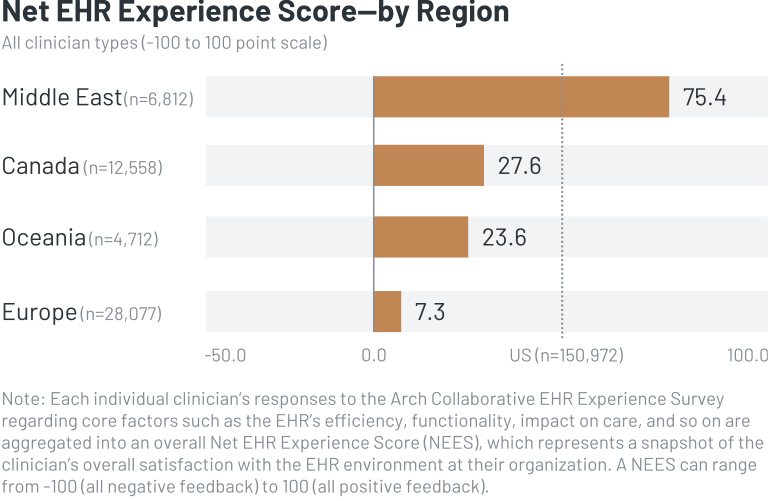
Now that many organizations worldwide have taken that initial step back, they are focused on moving forward. In this regard, the Middle East has made impressive strides—particularly in terms of optimization; clinicians in the region are far-and-away the most satisfied with their EHRs. One contributing factor is resources—organizations in this region often have more funding and support, both during implementation and for ongoing EHR improvements.
Universal Best Practices for Improving EHR Satisfaction
In the Global EHR Satisfaction 2025 report, we outline several universal best practices for improving EHR satisfaction. It’s incredible that these best practices are truly universal. Regardless of race, language, religion, and other differentiating factors, people get sick around the world and need to be treated, and EHRs are designed to facilitate the process of treating patients who need care, no matter what region they live in.
While it isn’t great that clinicians’ EHR challenges are so widespread, it is helpful to know that they are shared. And what’s even better is that the solutions tend to be similar, regardless of where you are in the world.
The Arch Collaborative’s EHR House of Success, which is a framework we developed a few years ago and on which our universal best practices are built, has really stood the test of time. The core principles include IT infrastructure, training, governance, and personalization, and these components continue to drive clinicians’ EHR experience.
The Arch Collaborative has found that about 30% of a clinician’s experience is tied to the features and functions of the EHR: how intuitive it is, how well it is designed, and how well it integrates with other systems. The other 70% comes down to what we often refer to as the human and organizational factors, like onboarding and ongoing education, how supported clinicians feel by their IT and informatics teams, and whether they know where to go for help.
The EHR experience is also impacted by how change requests are handled and whether clinicians feel heard in that process. A big part of this is whether they feel represented—ideally by someone who understands their clinical role, or even better, someone from their own specialty or department. This is what we refer to as shared ownership, or governance.
The good news is that these are areas where organizations can make meaningful changes relatively quickly. While not everything can be fixed overnight, improvements in training and governance can often be implemented over the course of a few months to a year—and they can have a real impact on clinician satisfaction.
Burnout Is a Challenge for Clinicians Worldwide, Though One Region Defies the Trend
This report also looks at clinician burnout rates. It is important to acknowledge that clinician burnout is not confined to any one region or country—it is a universal challenge affecting healthcare organizations globally. The one outlier is the Middle East; yes, clinicians in the region still experience burnout, but the rate is much lower compared to other regions, even the US.
Additionally, the percentage of clinicians citing their EHR as a burnout contributor is the lowest in the Middle East. This finding is remarkable and definitely warrants further study from KLAS. We want to better understand what they are doing to support their clinicians.
One possible factor is system speed and reliability in the Middle East. They score the highest in this area, which is significant, given that it is hard to build anything meaningful—like EHR training, governance, or personalization—on top of a system that is slow and unreliable. That correlation is worth highlighting.
Looking to the Future
Looking ahead, we hope more and more organizations worldwide start or continue measuring their clinicians’ EHR experience. We would love to get to the point where we can look at satisfaction by country instead of just by region. That would allow us to show more detailed, country-by-country comparisons and share deeper insights.
Even though we aren’t at that point yet, we’re excited that more organizations globally have started measuring and improving their clinicians’ EHR experience via the Arch Collaborative. Our hope is that this report will inspire your organization—regardless of location—to take the next step and evaluate which strategies you should implement to achieve EHR success with your clinicians.
Be sure to check out the full report for all the details.
© fizkes / Adobe Stock


