

Deciding on a go-forward EHR is one of the most important technology purchases a healthcare organization will make. Given their long-term impact, these decisions are often years in the making, especially when internal or external factors create uncertainty or redirect investment resources toward other priorities.
Such factors were certainly at play for healthcare organizations in 2025, leading to a noticeable slowdown in EHR purchase decisions. KLAS’s latest report on EHR market share among acute care and specialty hospitals in the US explores this shift in momentum as well as other trends in hospital EHR purchasing from January through December 2025.
Fewer Decisions, More Deliberation
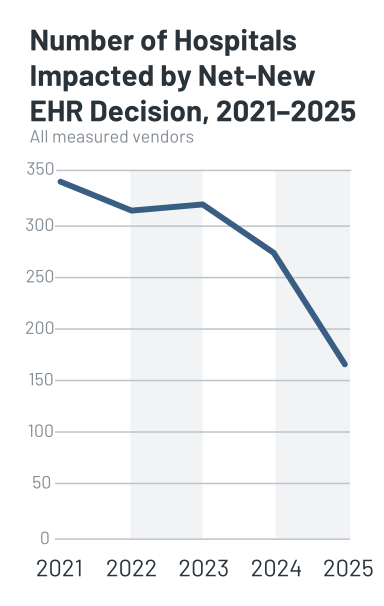
One of the clearest takeaways from the report is the decline in EHR purchasing activity. The number of hospitals affected by new EHR decisions dropped significantly compared to prior years: down 40% compared to 2024 and 50% compared to 2023.
This slowdown appears to be tied to a combination of internal and external considerations. Ongoing uncertainty around government policy has made some organizations hesitant to commit to large-scale IT investments. At the same time, many health systems are evaluating EHR investments alongside a broader set of priorities, including investments in technologies such as AI and advanced analytics that are aimed at delivering more immediate financial or operational returns. Organizations seem to be taking a more cautious, timing-focused approach—waiting until conditions feel more certain before making major EHR decisions.
Where Activity Is Still Happening
Even in a quieter year, the market didn’t stand still. In 2025, 60 US healthcare organizations—from specialty hospitals to critical access facilities to large health systems—made an EHR purchase decision (including migrations). These contracts represent 164 hospitals (compared to 2024’s count of 272).
A majority of the hospitals impacted were part of large health systems. However, these organizations’ purchases did not outpace the market as much as they have in previous years—in fact, just two health systems with over 10 hospitals made an enterprise-wide EHR decision in 2025, and both chose Epic.
Decisions by small health systems and standalone hospitals accounted for a larger portion of purchase activity than they have in years past: in 2025, 60 hospitals were part of small health system decisions, while 22 standalone hospitals under 200 beds made a go-forward EHR decision. Facing financial and operational headwinds, small hospitals and health systems continue to look for go-forward solutions that offer a breadth of capabilities without requiring significant operational resources.
A Closer Look at Vendor Dynamics
KLAS validated net-new EHR purchase decisions in 2025 for just five acute care EHR vendors—Altera Digital Health, Epic, MEDITECH, Oracle Health, and TruBridge. Epic and TruBridge were the only two to achieve a positive net change in market share, though MEDITECH saw their strongest year yet in terms of retaining legacy customers—of the 44 legacy MEDITECH customers that made a go-forward decision in 2025, 84% chose to migrate to MEDITECH’s go-forward Expanse platform.
A Note About KLAS’s Market Share Data
KLAS’s market share data comes from multiple sources, including publicly available information and the thousands of conversations KLAS has with healthcare organizations each year. KLAS also gives vendors the opportunity to report their annual acute care hospital EHR wins, which KLAS then validates with healthcare organizations. While KLAS believes the data in the report is directionally correct, we acknowledge that some variation may result from lack of vendor participation.
For 2025 decisions, all vendors except Oracle Health provided a list of wins, marking the second year in a row Oracle Health has declined to share new contracts. To independently identify Oracle Health’s 2025 wins, KLAS relied on our internal research methods as well as publicly available information. Therefore, the data for Oracle Health may not encompass 100% of their new contracts, particularly among smaller hospitals, whose purchase decisions are less likely to be publicized.
What to Watch Moving Forward
If there’s one consistent theme throughout the report, it’s that the market remains active but more selective. Decisions are being made, but they are often being given additional scrutiny and are being made by different types of organizations than in years past.
Healthcare organizations are emphasizing timing, value, and alignment with long-term strategy. Vendors, in turn, are operating in an environment where differentiation increasingly depends on more than just core functionality—healthcare organizations are looking for strong partners who will listen to feedback and provide needed support. For healthcare leaders, understanding not just what is changing—but how quickly and why—can provide valuable context for navigating the road ahead.
It will be worth watching how the following factors develop over the next year:
- Will conditions stabilize enough for organizations to move forward with deferred decisions?
- Will vendors be able to address evolving expectations around interoperability and usability?
- How will emerging technologies influence future EHR strategies?
To gain additional market share insights—including comprehensive details on each vendor’s 2025 wins and losses, current market share, and customer satisfaction—access the full report: US Acute Care EHR Market Share 2026: Market Uncertainty Significantly Cuts Buying Decisions.
© kanruthai / Adobe Stock


