In the rapidly evolving healthcare industry, organizations face numerous challenges in maintaining operational efficiency and delivering high-quality patient care. Healthcare management consulting (HMC) firms play a crucial role in addressing these challenges by supplementing an organization’s strategic expertise and ability to solve complex problems. The firms’ wealth of knowledge and experience can help organizations navigate complicated regulatory environments, optimize processes, and implement innovative technologies.
KLAS recently published our 2025 Healthcare Management Consulting report. In it, we share (1) the scope and type of validated HMC services provided by firms and (2) how those firms perform. In particular, the report examines Chartis, Deloitte, ECG Management Consultants, Guidehouse, Huron, and Impact Advisors. Our hope is that the report will help prospective clients determine which firms may be best suited to meet their complex needs.
KLAS’ Healthcare Management Consulting Framework
Under the umbrella of HMC, KLAS measures six consulting areas, defined below. The recently published report looks at firm performance in each of these areas, in addition to HMC overall.
- Financial/clinical improvement consulting: Consulting engagements focused on improving the financial, clinical, or operational performance of a healthcare organization; can include reducing costs, increasing net revenue, and/or improving efficiency. Engagements often assist with redesigning the revenue cycle, are very large in scope and investment (i.e., exceed $500K), and are over six months in duration.
- Strategy, growth & consolidation consulting: Consulting engagements focused on helping healthcare organizations with growth, innovation, and consolidation; can include developing organic or acquisition-based growth strategies, enhancing integration between healthcare/payer organizations, improving leveraged growth, and other projects.
- Human capital consulting: Consulting engagements that help healthcare organizations better manage their people and culture; work is often focused on helping organizations achieve their goals of attracting great talent, improving retention, and improving employee performance.
- Digital transformation consulting: Consulting engagements intended to help healthcare organizations better understand, interact with, and effectively engage consumers by integrating digital technology into all areas of business. The results can fundamentally change how a health system or payer operates, engages customers, and delivers value to patients.
- Value-based care consulting: Consulting engagements focused on helping organizations plan for and transition from fee-for-service operations to value-based care (VBC) models. Includes VBC clinical and operational readiness assessments, strategy development, implementations of VBC initiatives/programs, VBC optimization engagements, and any other advisory services directly related to VBC.
- Payer strategy & contracting consulting: Consulting engagements focused on developing payer strategy, relationships, or contracting with the aim of optimizing payer revenue streams, margins, or operational efficiency. Engagements often assist with current state assessments, contract reviews, strategy development, contract negotiation, reimbursement modeling, and other payer-related advisory work.
Market Trends
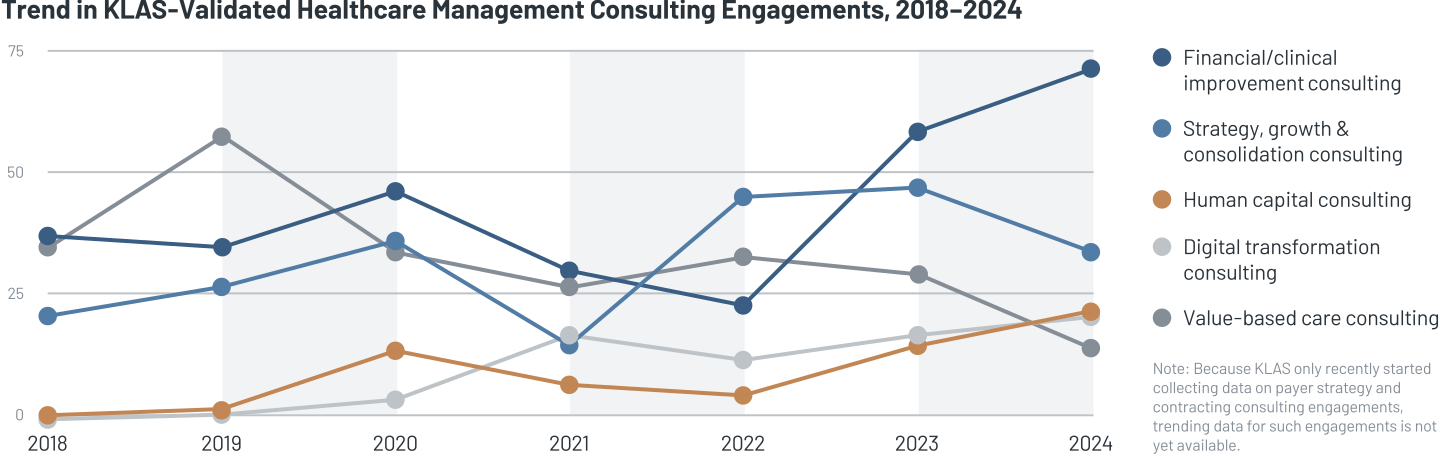
The number of validated financial/clinical improvement consulting engagements has steadily increased since 2022, despite strategy, growth, and consolidation being reported as the top priority in the 2024 report. Although respondents still want help fueling strategy and growth, they are seeking to accomplish this via financial/clinical improvement (e.g., increased revenue, greater ability to navigate margin pressures). Additionally, value-based care consulting engagements have declined since their peak in 2019; this suggests that organizations are struggling less with the operational challenges of moving from a fee-for-service model to a value-based care model and are instead dealing with broader issues around leveraging both types of models to achieve financial success.
Poor Engagements Are Rare—Learn How to Avoid Them
The report looks at multiple firms across the six market segments making up the HMC framework. Notably, across all measured firms, it is uncommon for interviewed clients to report a poor experience; for most firms, only 5%–10% of interviewed clients report gaps or improvement opportunities. However, those who report lower satisfaction often share similar friction points that could have been prevented with a focus on partnership, alignment, and communication.
Clients want three elements: experienced consultants, a close partnership with the firm, and expertise tailored to the client’s unique needs. When these aren’t present, clients perceive the engagement as less valuable, regardless of its cost. To avoid friction, prospective clients should consider the following when looking to partner with a firm:
- Prioritize scoping and alignment: Work as closely as possible with firms to get a clear picture of what is needed. Don’t cut the discovery process short.
- Facilitate clear, open communication among stakeholders: Stakeholders from both parties must have a shared understanding of what success looks like. Be up front about expected outcomes, and document the expectations so that stakeholders from both parties can reference them regularly throughout the engagement. A few interviewed organizations used at-risk contracts to more effectively drive alignment; while this approach isn’t required to achieve alignment, it can be very beneficial.
Read the Report for Details on Firm Performance
As we shared above, most interviewed clients report being satisfied with their firm’s engagement. However, some firms are better suited to certain engagements than others, especially when factoring in an organization’s type and size; both elements heavily influence the strategies and expertise required for organizational success. We encourage prospective clients to closely evaluate different firms to determine which could best meet their unique needs.
Read the report to aid in your evaluation process and see comprehensive insights on firm performance.
© Halfpoint / Adobe Stock