As healthcare organizations contend with increasing complexity and growing demands, many are making substantial investments in their IT infrastructure, with the public cloud assuming a central role. While initially met with caution due to concerns around data security and regulatory compliance, cloud platforms are recognized by many as essential for sustaining operational efficiency and fostering innovation. These strategic investments are not only optimizing routine operations but also enabling advanced capabilities in areas such as AI, genomics computing, and digital pathology.
To better understand the current state of organizations’ IT infrastructures, KLAS recently published a report examining the following:
- How much of organizations’ infrastructure is on premises
- Organizations’ experience with public cloud providers
- Organizations’ future plans with cloud providers
- General infrastructure priorities and roadblocks
Current State of Organizations’ IT Infrastructure
Nearly 40% of respondent organizations say that the vast majority of their infrastructure is on premises. However, cloud adoption is widespread among respondents, with most leveraging a public cloud provider.
The depth of cloud adoption varies—only one respondent has fully migrated their infrastructure to the cloud, and another has moved a large majority of their infrastructure to the cloud. Both of these organizations use Microsoft Azure. Also of note, most cloud users use a single cloud provider instead of multiple.
The organizations that have most of their infrastructure on premises say that cloud migration is one of their top three priorities over the next 12–24 months, suggesting that public cloud adoption throughout the healthcare industry will continue to expand over time.
Insights on Public Cloud Providers
In this report, we wanted to provide an overview of what public cloud providers are being used and share how those cloud providers are perceived by current customers and by organizations who evaluated the cloud provider without signing a contract.
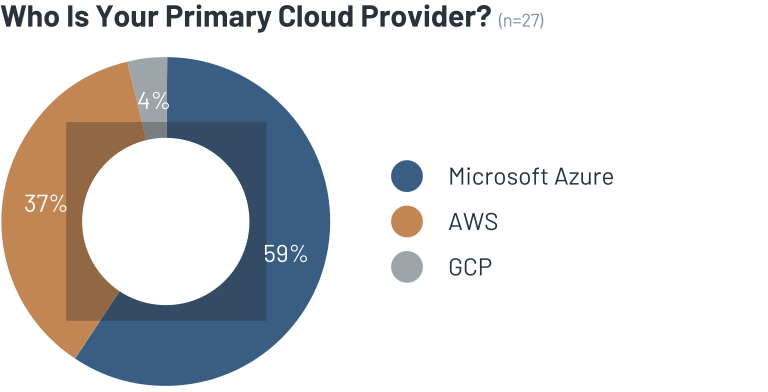
We learned that Microsoft Azure is the most commonly used primary cloud provider in the report sample and that they are also commonly used as a secondary cloud provider. Organizations especially appreciate Microsoft’s enterprise software ecosystem. AWS is also used by a solid portion of respondents, and the cloud provider stands out for their cost flexibility, infrastructure reliability, and breadth of services.
Google Cloud Platform (GCP) is seen as less relevant in the healthcare industry, and only one respondent uses them as a primary cloud provider.
Also of note, KLAS asked respondents how they perceived Microsoft Azure and AWS in the following key areas: cost/value, ease of integration, healthcare industry expertise, operational resilience, technology stack, and security and compliance. Both cloud providers are perceived well for technology and operations, and both have opportunities for improvement around expertise and cost. For further details, be sure to check out the report.
The Top Priority for Future Infrastructure Investments
We wanted to know what infrastructure investments organizations plan to make in the near future, and—as was previously mentioned—cloud migration is a high priority for many. However, it isn’t the most-mentioned priority; instead, respondents most frequently cite cybersecurity enhancement.
With the rise of cyber threats targeting patient data and clinical operations, respondents feel the need for robust defenses, including infrastructure hardening, privileged access management, and compliance with HIPAA and PCI standards. Many organizations are adopting managed detection and response services and hiring virtual CISOs to ensure continuous monitoring and resilience.
Looking Forward: Public Cloud’s Role in Healthcare
The public cloud is set to become a foundational element of healthcare IT infrastructure. As digital transformation accelerates, cloud platforms will enable advanced capabilities such as real-time data exchange, AI-driven insights, and precision medicine. With continued progress in security and compliance, adoption will expand, positioning the cloud as a key driver of operational efficiency and improved patient outcomes.
As these developments unfold, KLAS intends to publish ongoing research to provide timely insights into the evolving role of the public cloud in healthcare.
For more details, check out the report.
© khunkornStudio / Adobe Stock