

With resources under intense scrutiny, healthcare leaders must be highly selective about where they invest time and money. For some, participating in the KLAS Arch Collaborative to improve their clinicians’ EHR experience feels like a nice thing to do, not a necessity. So it makes sense that with the current healthcare climate and limited funds, more healthcare organizations ask KLAS about the ROI behind improving the EHR for clinicians.
Over the years, we’ve answered this question more anecdotally, pointing to our data showing that training is impactful and that giving clinicians a voice is important for success. But it’s been truly exciting that in our report The ROI for Improving Your Clinicians’ Experience 2025, KLAS validates the real ROI healthcare organizations see when they prioritize their clinicians.
Points to Know
- Investing in clinician experience delivers real ROI—for example, 63% of healthcare organizations saw reduced burnout, and 38% saw lower turnover after prioritizing EHR improvements.
- Other benefits also emerged, including improved patient perception and stronger organizational culture driven by listening to and acting on clinician feedback.
- Successful organizations followed multifaceted strategies, often aligning with the EHR House of Success—emphasizing strong technology foundations, EHR governance, and EHR education.
- This report is essential reading for healthcare organizations not yet measuring clinician experience, those struggling to act on data, and vendors/firms seeking to demonstrate ROI.
Read on to learn more.
Key Findings
The results shared in our new ROI report come from 16 healthcare organizations in the Arch Collaborative that have spent time and money investing in their clinicians’ experience. Thanks to these members, we now better understand both the outcomes that they wanted to achieve and the outcomes they actually see.
We learned a lot about the outcomes leaders hoped to achieve. On that list were things like increasing clinician efficiency and decreasing burnout and turnover. These are all key, top-of-mind priorities for healthcare organizations. And we were blown away by the results of their deliberate efforts. You can see them in the chart below, but I’ll highlight two here: 63% of participants saw a decrease in clinician burnout, and 38% saw a decrease in clinician turnover. The report talks more about the financial impact of those results, so I recommend reading for more in-depth information.
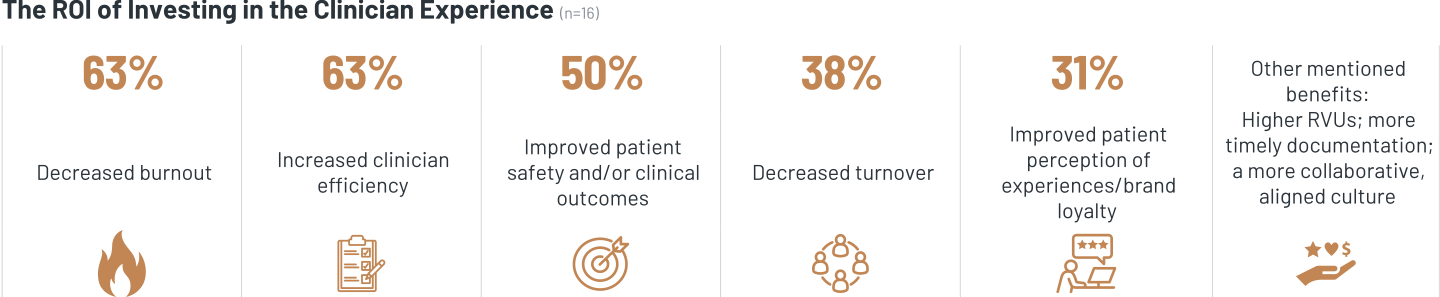
There were some additional, less expected outcomes. 31% of participants mentioned having an improved patient perception of their care and their brand loyalty. These healthcare organizations said that they expected that having happy doctors and nurses would feed into having better patient encounters, so it was incredible to see that come out in the research.
It’s really hard to measure culture, but a few people talked about how measuring clinician experience and responding to clinicians’ feedback has really created a collaborative environment.
One physician and director of clinical informatics even told us: “Culture is a soft metric that is highly consequential. It’s not the kind of thing people can enter in a spreadsheet to prove a monetary ROI, but culture is a massive metric. Our culture has improved because we invested in improving the clinicians’ experience. There are innumerable factors to culture, but we have created a strong presence with our providers. We let them know we are listening to them and making changes. We get in front of the providers every quarter to let them know about major changes that are coming based on the pain points they have reported. I think this matters a lot.”
Multifaceted Strategies: The EHR House of Success
This report would be incomplete without a look at what the 16 organizations specifically did. And it was very validating that many of them talked about mobilizing their teams following our EHR House of Success. They mentioned having third-party tools, but to make those useful, they first needed to have a strong technological foundation and to make sure they also had robust EHR governance and effective EHR training.
The EHR House of Success helps people to visualize the clinician experience, and it runs true for a lot of these healthcare organizations that have followed it, even unintentionally. Ultimately, it is a really good place to start when you have unhappy clinicians. There’s a myriad of reasons why, but when you think about their interaction with technology, if they can’t use the system quickly and effectively, that’s the beginning of their frustration.
Your Challenge: Read the Report
This report is for any healthcare leaders who want to know what they can do to improve their organization, but there are three groups that I hope take special notice of this report:
- Healthcare organizations that are not currently measuring clinician experience for any reason: This report is a good opportunity to understand the ROI of doing so and why it’s critical. Whether you measure with KLAS or not, we want you to at least measure; the financial risk is too high not to measure and act on your clinicians’ feedback.
- Healthcare organizations that are measuring but have a hard time getting the resources they need to act: For example, your data says your organization struggles with training, but you can’t afford a new virtual learning platform, or more trainers. This report gives you a way to show verified reasons why you need those necessary resources.
- Vendors and firms that have products and services that help with clinician experience but have a hard time positioning their offerings: A lot of vendors and firms feel there are challenges healthcare organizations face that they can help with. But sometimes they struggle measuring the hard ROI of their products and services. If this is you, we hope you can share this report with your prospective clients to talk about how you support clinicians having a better EHR experience.
So if you’re already an Arch Collaborative member or just getting curious about how others are seeing success in improving their clinicians’ experience, my hope is that you’ll go read the report. See what you can learn to drive change for the betterment of clinicians worldwide.
© Halfpoint / Adobe Stock


